

Every now and then you hear a story that shakes loose something inside you. It could be a memory, a belief, a question you didn’t know you were still carrying.
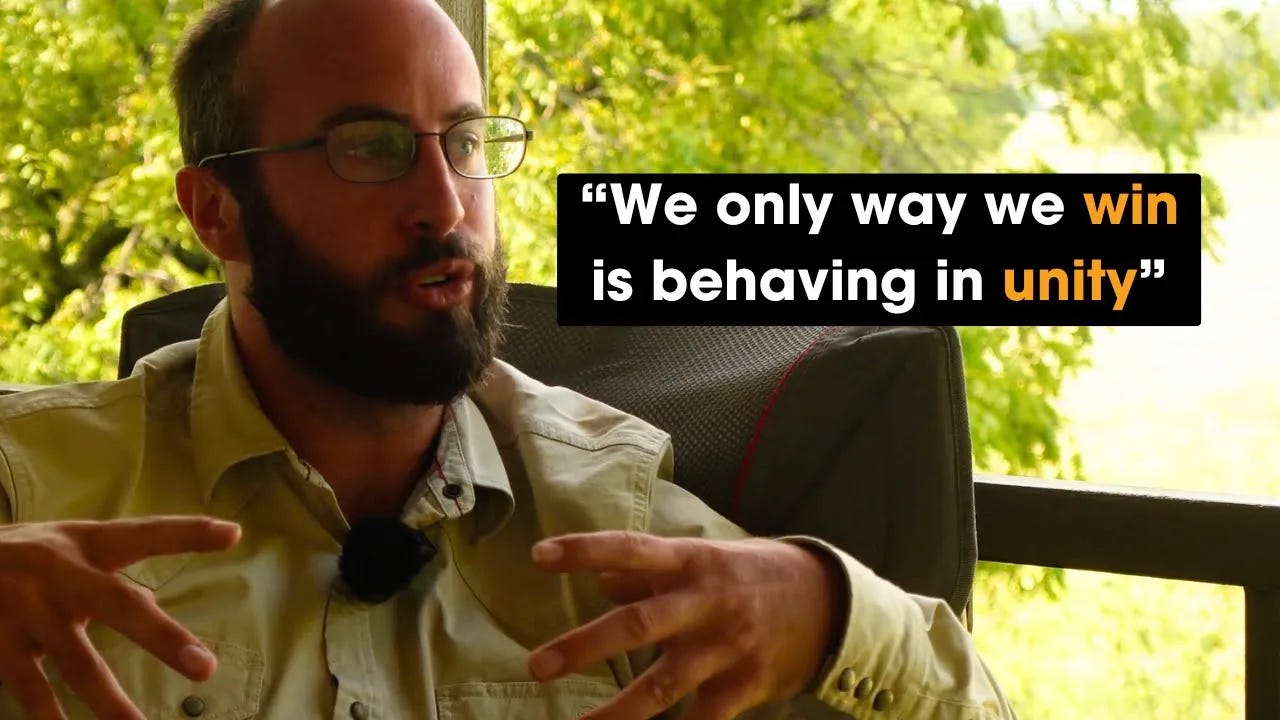
That happened during my recent conversation with Joel Hollingsworth. A friend, rancher, builder of herd-share models, and one of the few people speaking plainly about what’s actually killing rural America… and what might still save it.
America didn’t lose rural life because families got weaker. America lost rural life because we stopped behaving like families.
And the path back is far more ancient, practical, and hopeful than most people realize.
We Were Never Meant to Homestead Alone
Joel opened with a line he’d shared at ACRES:
“In order to be economic, agriculture must be ecological.”
Then he added the part that changed everything:
“But you also have to measure value on a long enough timeline… and root it in collaborative relationships.”
Collaborative relationships.
Not networks.
Not co-ops.
Not “community” in the shallow, Instagram-friendly sense.
He meant middle-class families acting together with enough unity to actually influence the world around them. The way frontier families once traveled west in wagon groups, not as isolated nuclear units.
Joel didn’t romanticize it. He just told the truth plainly:
Most ranches in America have 22 cows.
A viable ranch needs 500.
That gap isn’t a moral failure, it’s a math failure.
A design failure.
A cultural failure.
Almost 90% of ranches are too small to survive without off-farm jobs, tax write-offs, or subsidies. These are not thriving businesses. They are rural families white-knuckling their legacy while their land, energy, and time get extracted upward into the BlackRocks of the world.
To pretend the solution is individual grit is, as Joel said, “a LARP.”
The Model That Changed Everything: Families Owning the Herd Together
Joel’s ranch didn’t scale because he hustled harder.
It scaled because he changed who the ranch was for.
Instead of one family trying to build a 500-head ranch alone, Joel built a herd-share model where dozens of local middle-class families became shared owners of the breeding stock.
People who once stored their savings in ETFs and index funds started storing value in… cows.
Not because it was trendy.
Because they finally saw the truth:
Money stored in Wall Street leaves your community.
Money stored in cows feeds your community.
Every year, when calves are weaned, the families split them, receiving food security, asset security, and a stake in a regenerative regional economy.
Meanwhile, Joel gets the scale he needs to operate like the big guys without becoming one of them.
Instead of a thousand isolated ranches with 22 cows each, he built one unified organism capable of:
negotiating in markets
withstanding volatility
accessing better processors
actually influencing legislation
and rebuilding rural wealth from the soil up
He calls this local vitalism.
It’s not a slogan, it’s a survival mechanism.
Rural America Is Not Your Enemy… It’s Been Hollowed Out Just Like You
Why does regenerative, local food look so “expensive” to consumers who assume farmers are raking it in?
Joel answered with a truth few dare to say:
“Rural America, productive America… is not your enemy. You’re being pitted against each other.”
The farmers people imagine “living off the land” often live in food deserts.
Many don’t eat what they produce.
Many survive on fast food, long hours, and low margins while their land is trapped in monocrop systems and their processing options are strangled by policy designed by corporate lobbyists, not safety experts.
Legislation written for 100,000-head processors gets forced onto the tiny 100-head local butcher down the road which effectively outlaws the small-scale infrastructure rural America needs to feed itself again.
It’s not incompetence.
It’s not coincidence.
It’s consolidation.
And the only counter-force powerful enough to resist it is groups of families acting together with scale, coherence, and shared self-interest.
The Story That’ll Stop You Cold
In the middle of the conversation, Joel shared a story from his dad — a story that felt like a window into the America many of us sense we lost.
His father grew up in a small farming community. One year, a local family fell behind with medical issues, bad harvest, something had gone wrong.
That year, storms were coming during harvest season.
And without a meeting, without a discussion, without any permission…
every farmer in that community harvested the struggling family’s fields first.
Only after that did they harvest their own.
I asked Joel:
“Was it charity?”
Joel shook his head.
“No. It was survival. If that family failed, a brick came out of the foundation of the entire community.”
That one line landed like a hammer.
Because we all know he’s right.
A community is not a collection of individuals. It’s a web of families whose futures are braided together.
A rural town can afford one bad harvest. It cannot afford the collapse of a pillar family.
We’ve forgotten that.
We’ve been atomized into thinking: “I just need to look out for my own.”
But the truth is what Joel’s grandpa knew:
Your long-term self-interest is inseparable from the health of the families around you. Your kids inherit the world those other families help maintain.
That kind of thinking built America.
Its absence is what is breaking it.
So What Do We Do Now?
Joel doesn’t sell fantasies. He sells agency those aspiring to make a change.
The path forward is the same path that got those frontier wagons safely across the plains:
Families banding together to create resilient, local, regenerative economies — together or not at all.
This means:
• Collaborative herd ownership
• Shared processing infrastructure
• Regional food systems owned by the people who eat from them
• Middle-class families investing in land and livestock instead of Wall Street abstractions
• Rural and urban Americans unlearning the manufactured hostility between them
And most importantly:
A return to the belief that your neighbor’s survival strengthens your own.
If one family sinks, the entire rural ecosystem weakens.
If families rise together, you get a community that can:
• push back against consolidation
• withstand volatility
• feed itself again
• rebuild generational wealth
• raise healthy children in healthy places
This isn’t nostalgia. This is strategy.
This is how rural America regenerates, not as isolated homesteads, but as interdependent networks of families reclaiming their power.
The frontiersmen weren’t lone wolves.
They were caravans.
Maybe we should be again.
If This Resonates, You’re Part of the Work
Rebels, this movement isn’t theoretical.
It’s not intellectual.
It’s not “content.”
It’s a blueprint.
Joel isn’t just describing a world that could exist.
He’s describing a world that used to exist! A world that is still possible if we refuse to let rural life be harvested by the same forces that hollowed out our cities.
The Regenaissance was built for this moment, not to romanticize the past, but to regenerate the future.
And it starts with us remembering what America forgot:
We rise together, or we don’t rise at all.
If you want this movement to grow, share this piece — and keep showing up. Your energy feeds the soil of this community.
Stay rooted. Stay loud. Stay together.
Viva La Regenaissance!
- Ryan Griggs, Founder
If you want to feel the weight of Joel’s words—not just read them—go watch the clip on YouTube. Some things hit differently when you hear them from the source
Big thumb's up but one warning: if this isn't AI it reads like AI, in "It's not X it's Y." This is snappy, that's why it does it, but there's an enormous backlash against it and it's making people nauseous, rejecting the whole meal.
Give it a go and be careful as the message is important.
So many quotable from this article.