

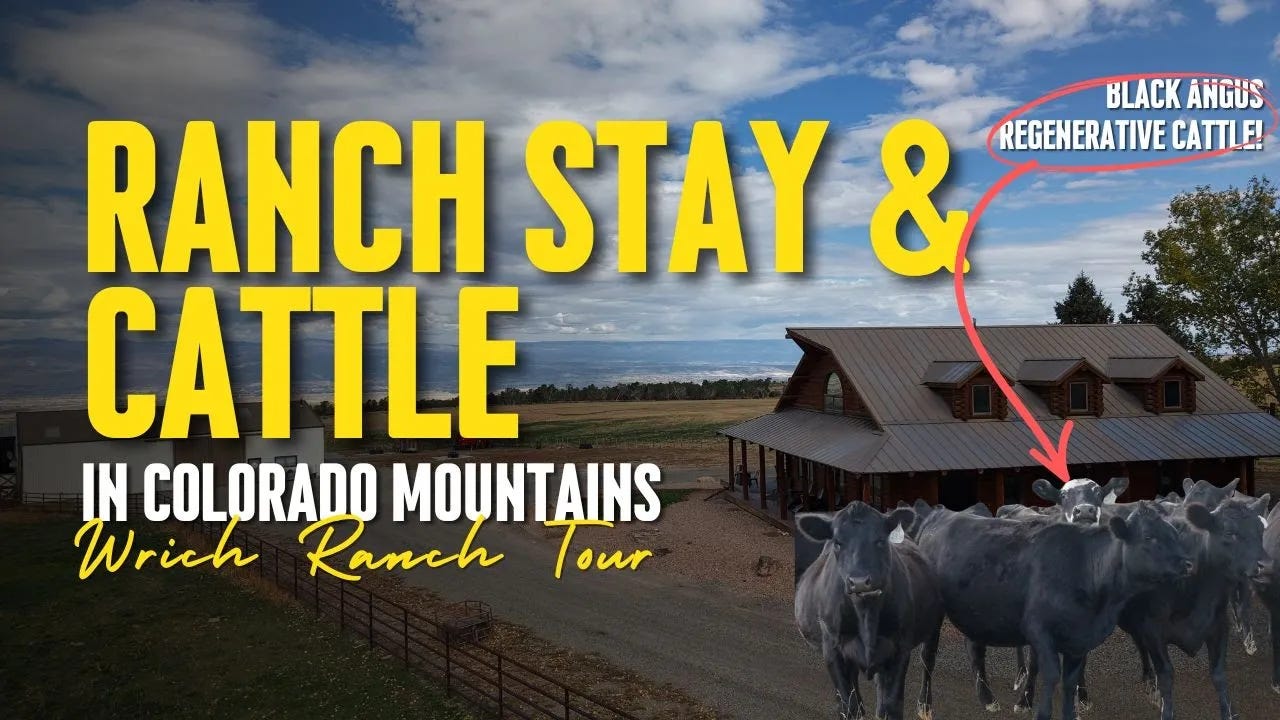
There’s a moment on every ranch when the world gets quiet, not silent, but quiet in a way where you feel “something different” in the air. The wind slips across dormant grass. Cattle chew their cud in a rhythm older than any city. And for a rare moment, you can feel your body drop out of the frantic pace of modern life and into something more ancient, more honest, more human.
If you’ve never stood on land like this before, be prepared: a regenerative ranch can rewrite everything you think you know about food.
I saw it happen to a guest before it happened to me. She stepped onto the porch of the Airbnb at Wrich Ranches in western Colorado just as the sun was coming up ,wearing pajamas, holding a mug of coffee, her hair still messy from sleep. And then she froze. Completely still, as if the mountains had reached out and grabbed her attention by the shoulders.
Jason Wrich, the rancher hosting her stay, laughed when he told me about it later. “CGI couldn’t fake this,” he said. And he’s right. Some beauty only feels real when you’re standing in the middle of it.
The Part of Ranching Most People Never See
Spend enough time online and you’ll see the same videos circulated over and over: calves being weaned, cows calling out, ranchers portrayed as heartless. But standing in the pens with Jason as he explained his process, you realize most of those clips are disconnected from context (which is everything!!)
Jason told me something that has stayed with me ever since: “Our cows have such strong mothering instincts they’ll let an 800-pound calf keep nursing while they’re already pregnant with the next one. They’ll never wean naturally.”
If you’ve never been around livestock, this seems surprising. If you’ve been shaped by online narratives, it seems harsh. But the truth is far more complex and humane.
Jason offered an example that catches most people off guard. “I don’t know if anyone’s ever watched elk have twin calves,” he said. “They only let one of the calves suckle. The other gets kicked off and starves.”
That is “mother nature.” Not peaceful, not utopian, not the wildlife documentary version most people imagine.
So when ranchers intervene, it isn’t out of cruelty. It’s out of stewardship. Jason weans calves while giving them access to clean hay, high-quality minerals, and continuous fresh water. He monitors every cough, every snort, every behavior that could signal an issue.
“Sure, it’s stressful for a couple days, …but our job is to set them up for success. The mothers won’t do it on their own.”
When you hear it directly your perspective shifts. You start to see ranching not as an industrial act, but as a relationship between land, animals, and people.
Regenerative Ag Is Stewardship, Not Magic
Walking Jason’s pastures, you quickly notice the drought long before you notice the cattle. Eighty-two straight days without rain. Water rights that depend entirely on snowpack in a distant basin. Out of twenty years, he told me, only three have been what he’d call “good years.”
Yet the way Jason talks about the land isn’t resentful or extractive. He talks about it as if it’s a living thing he’s responsible for and in partnership with.
He refuses to use synthetic fertilizer, choosing instead to build soil by bringing in hay from trusted farmers. “When you buy a ton of hay,…you’re bringing in all the NPK, all the carbon, everything that builds soil. It’s not just feed. It’s fertilizer going through a beef animal first.”
His operation is interwoven with his community in a way most modern consumers never experience. The tea in his store is grown in Hotchkiss. The coffee is roasted in Paonia. The bath salts, the handmade jewelry, even the T-shirts, all come from people he knows by name. You don’t just see food on shelves; you see relationships.
And then you walk outside and watch the cattle graze on cool-season grasses, the irrigation lines running across the fields, the recycled tire tanks keeping fresh water flowing, and suddenly you start to understand something: you can’t replicate this in a grocery store. You can’t mass-produce this. Regeneration isn’t a product, it’s a worldview.
Why Guests Leave Changed
Many families who visit Wrich Ranches end up returning year after year. They grill steaks raised on the same land they’re standing on. They buy local eggs, local sausage, local coffee, and gather around a meal that didn’t travel across the country to reach them.
The farm store operates on the honor system, open 24/7. There’s no cashier. No checkout counter. You walk in, grab what you want, pay with your phone, and leave.
Jason once installed a Ring camera, not to monitor theft, but because one guest accidentally walked out with half the inventory. When people ask him if he worries about people stealing, he always gives the same answer:
“If someone needs it that badly, let them have it. We’ve learned that when we operate with open hands and open hearts, we’re blessed tenfold.”
Hearing that, you can’t help but feel something soften inside you. It’s rare to see trust practiced so unapologetically.
Everyone Loves Regenerative Ag… Until They Open Their Wallet.
This part of the conversation hit hard.
Jason told me, “People say I’m doing a great job. They praise us. They love what we’re doing. But they don’t buy from us.”
He wasn’t being bitter, just honest. If you support regenerative agriculture in theory but still buy all your groceries from Costco, the system you’re funding isn’t the one you believe in. “You have to vote with your dollar,” he said. “Otherwise, there won’t be people like us left.”
You begin to see how fragile the movement really is. Without consumers choosing differently, regeneration won’t scale. It won’t survive. And one day, the only option left might be those massive 200,000-head feedlots in Nebraska where cattle stand on concrete with no grass in sight. That’s not a future anyone wants, yet it’s the future we drift toward when we don’t act.
The Return of the Village Model
Jason calls his customers his “beef tribe.” Some prepay for beef years in advance to help bridge difficult seasons. Others share equipment, storage rooms, wash-pack spaces. The farmers in this valley collaborate openly. Not because it’s they’re pressured or guilted into it… but because it’s necessary.
He told me about giving a talk in Denver where he mentioned that sometimes he wasn’t sure how he’d make the mortgage during drought years. Afterward, several beef customers approached him and said, “What if we prepaid for five years of beef?” Not as charity, but as partnership. As mutual survival.
It struck me that this is what America used to look like, not the romanticized frontier, but genuine community interdependence. We don’t need bigger systems. We need smaller circles, deeper relationships, and more local resilience.
A Regenerative Ranch Changes Your Diet And Your Perspective
As the sun lowered behind the mesa, Jason pointed out where the cattle would calve next week, where the cool-season grasses would rebound in spring, where the irrigation lines would run once the snowmelt arrived. He showed me the wedding barn he built using lumber he and his father milled themselves. He talked about stewardship as a deep calling.
And standing there, you realize something profound: most people don’t need more documentaries or studies or debates. They don’t need more fear-based messages about conventional food. They don’t need more doom.
What they need is to stand in a place like this.
To breathe it in.
To taste food grown here.
To watch cattle move across a pasture that’s been cared for, not stripped.
To see land that’s alive, not exhausted.
A regenerative ranch doesn’t just reconnect you to your food.
It reconnects you to yourself.
And once you feel that, truly feel it, you’ll never look at food, land, or the people who steward it the same way again.
Thank you for reading, Viva La Regenaissance!
-Ryan Griggs, Regenaissance Founder
If this story hit home for you, even if it was one phrase… I’d love for you to join the Regenaissance movement!
Become a paid subscriber so you can directly help us fund more ranch visits, farmer profiles, and the stories behind the people feeding America the right way.
If you have thoughts, questions, or your own experiences with regenerative farms, drop a comment below. I read every one.
And if you know someone who would appreciate this kind of deeper look at where our food comes from, share this piece with a friend. These stories travel best through people who care.
Finally, if you want to see Wrich Ranches with your own eyes, the full video tour is below. Watch the video and see this experience for yourself