

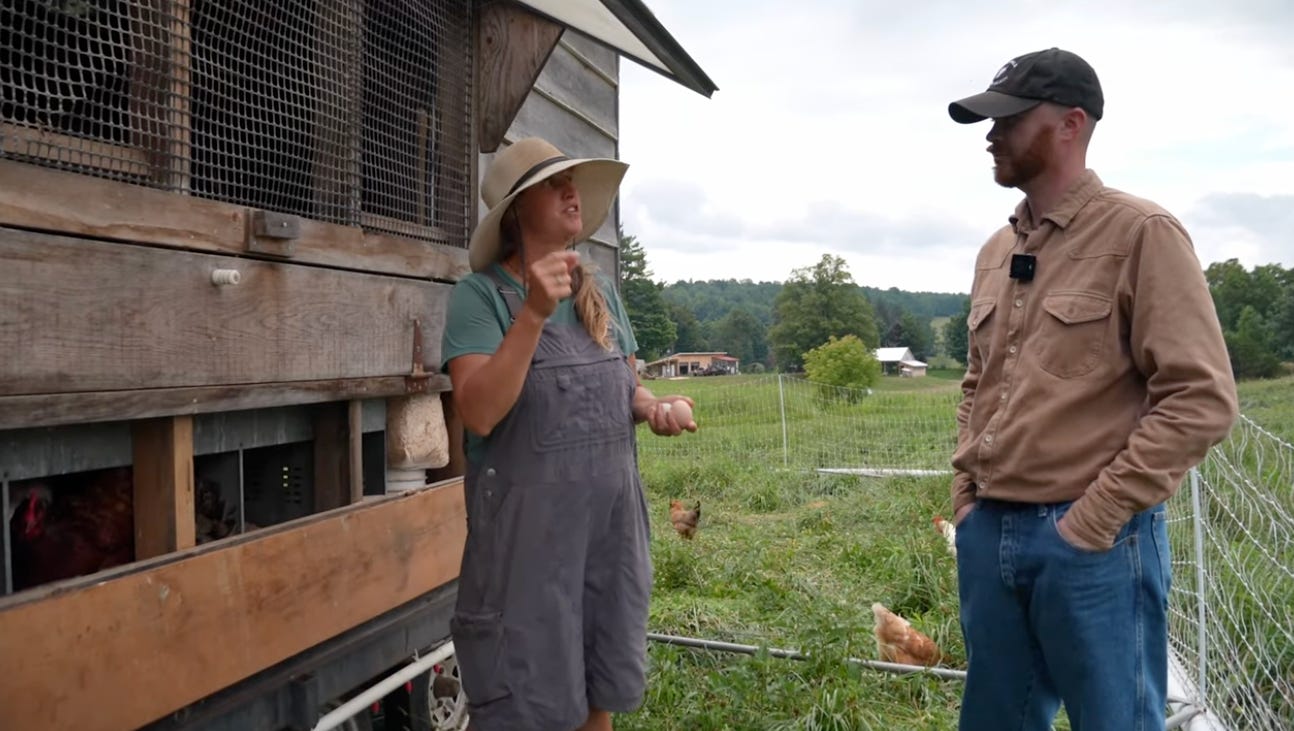
Otter Creek Farms, which now holds pigs, chickens, and cattle moving across pasture, was once managed very differently.
Before rotational paddocks and soil biology became the guiding metric, this farm in upstate New York functioned like thousands of others in the region: a conventional dairy shaped by efficiency, inputs, and inherited thinking about how farming had to work.
What makes this place different today isn’t the new faces or structures. It’s the human decision that reshaped it.
Elizabeth Collins is a first-generation farmer. She didn’t inherit this land through a neat lineage or marry into a thriving family business. Instead, she walked away from a previous life entirely to rebuild something new alongside fifth-generation farmer Brad Wiley.
Watch or Listen to the Full Farm Tour
This article is based on a full on-farm conversation at Otter Creek Farms.
→ Watch the complete farm tour on YouTube
→ Listen to the full podcast episode
A Farm With History and Friction
Like much of rural New York, the land carries a long agricultural memory. Dairy shaped the landscape, the infrastructure, and the expectations of what “success” looked like for generations.
Barns were built for confinement. Fields were managed for extraction. Output mattered more than resilience.
Elizabeth wasn’t raised inside the logic of “this is how we’ve always done it.” That freedom defined the early years and created no small amount of tension.
She speaks openly about the cost of that choice: leaving a job, leaving a marriage, and temporarily distancing herself from family. It wasn’t romantic. It was destabilizing. And it shaped how she approaches farming now, with humility about what real change actually demands.
Regenerative transitions don’t happen in a vacuum. They happen inside lives that already carry risk, responsibility, and constraint. All the trials of starting a farm are only compounded by the trials the farmers face.
Why This Wasn’t a Simple “Dairy to Regenerative” Flip
One of the clearest themes from the farm tour is that you can’t just quit and do a 180 — especially if you’re embedded in a conventional system.
Infrastructure locks you in. Debt locks you in. Markets lock you in.
In our conversation, Elizabeth made it clear that her path isn’t replicable for everyone. Instead, she frames the farm as a learning environment, not a prescription. The goal isn’t regenerative ideology or doing everything “by the book”. It’s learning how to adapt, something you only understand after moving through real change and uncertainty.
That perspective shows up everywhere on the land: fields that don’t look “perfect” by conventional standards, grass left to mature longer than planned, seed heads standing, and makeshift structures that reflect years of adjustment. What might look odd at first makes sense when viewed in the context of learning how to farm without generational knowledge.
Across the ranch, nothing is done because it fits a label. Decisions are provisional, shaped by what the land demands. In practice, regeneration is about paying attention, not control.
Learning to Read the Land Again
When we visited, we found cattle grazing mature forage that would normally be cut weeks earlier. A wet spring pushed haymaking back, the grass went to seed, and the timing was far from perfect. The cows weren’t happy and they let us know it.
But the system didn’t break.
Instead, the cattle were stocked tightly, moved intentionally, and used to trample mature forage into the soil. Seeds were pressed into the ground. Manure and urine fertilized the field. Roots went deeper because plants were allowed to fully mature.
“This wasn’t planned,” Elizabeth explains. It was improvised. It reinforces the idea that regenerative management is about how you respond when things go wrong, not trying to control for perfection.
She describes how farmers can measure forage with tools and formulas, but eventually your eye replaces the clipboard. You learn how long animals can stay in a paddock not from spreadsheets or watches, but by observing cow behavior, bite depth, and field recovery.
That shift from prescription to observation marks the real departure from conventional thinking.
Beyond Cows: Rebuilding a Whole System
The former dairy is no longer single-species by design.
Pigs rotate through ground to disturb, fertilize, and reset areas cattle can’t. Chickens follow ruminants to spread nutrients and manage insects. Each species plays a role without being forced into a system for maximum productivity.
Feed decisions are guided by outcomes, not ideology. Instead of assuming nutritional quality based on labels, the farm tests omega-3 and omega-6 ratios to see what the animals and land are actually producing. Grain is used strategically where it supports animal health and provides necessary calories when the land falls short.
Maybe the largest physical contrast from traditional dairy to modern regenerative ranching is that the infrastructure is lighter, more mobile, and deliberately imperfect. Permanence and large scale don’t fit into an evolving system.
Why the Consumer Is Part of the System
Elizabeth is clear that regenerative farming isn’t something farmers can do alone.
She’s skeptical of the idea that this regenerative food will wind up neatly packaged on grocery shelves. After all, physical and relational distance from farms is what allowed industrial systems to flourish in the first place.
It’s not realistic to expect more traditional farming practices to thrive in an environment ruled by modern expectations. Quick and cheap are what consumers expect, but that’s not what regenerative ranching (or nature) can deliver.
Instead, Elizabet talks about proximity: farm stands, on-farm meals, tours, and direct relationships.A return to a time when farms and communities worked together to support one another. When people taste food raised this way and see the land that produced it, something shifts. It becomes personal and they feel the responsibility to help the land flourish.
It’s not about growing the output to meet the eaters’ demands. It’s about shrinking the gap between eater and producer.
What This Farm Actually Represents
This ranch isn’t proof that regenerative farming is easy. It’s proof that it’s possible, even on land shaped by decades of conventional management.
It shows what happens when soil health becomes the decision-maker instead of yield targets, when animals are treated as ecological tools rather than units of production, and when adaptation is valued over rigid systems.
Just as importantly, it acknowledges human and ecological limits. That’s because the biggest change isn’t on the land, it’s in the people making the decisions. And that’s the hardest part.
This story won’t offer easy answers. It does offer a clearer picture of what change can look like, for farmers and consumers alike… gradual, imperfect, and shaped as much by people as by the land.