

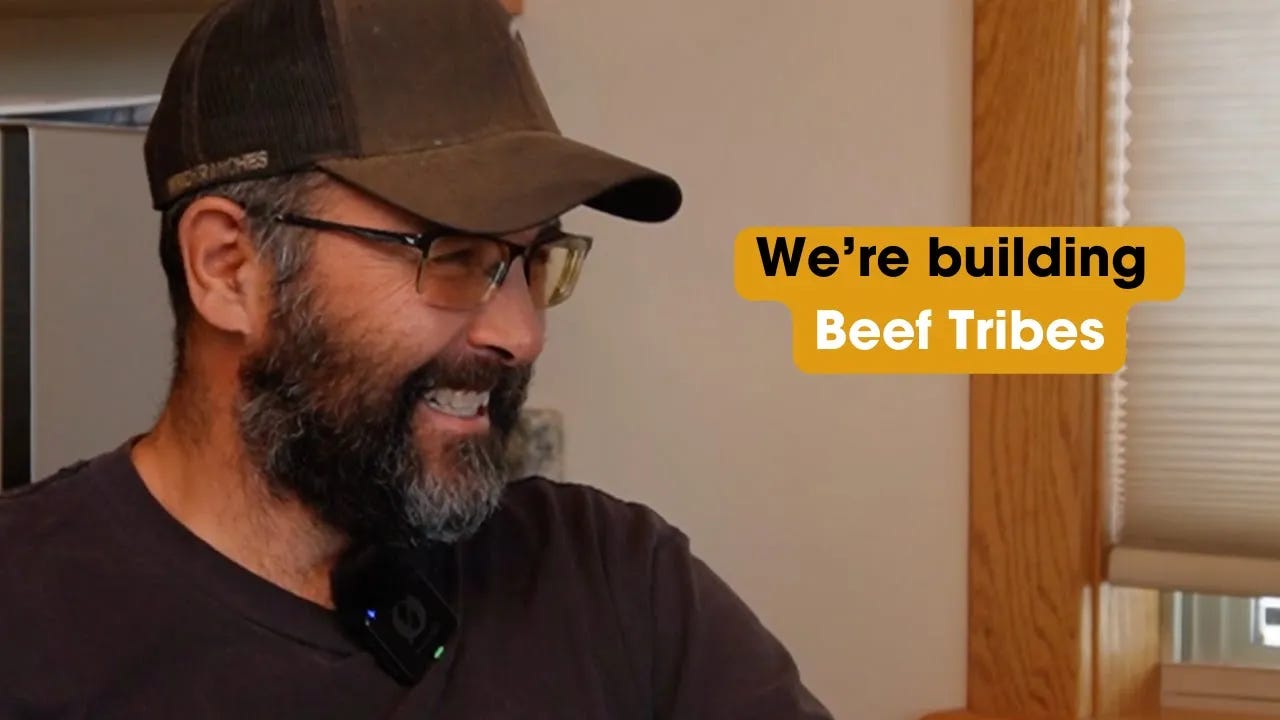
Over all the interviews with farmers and ranchers I had traveling across America, certain ones stuck out and made me rethink what it means to live a real human life. Listening to Jason Wrich talk about his ranch in Crawford, Colorado did that for me.
Jason is not one of those ranchers who inherited 3,000 acres and a brand. He didn’t grow up with cows or hayfields or irrigation boots. He grew up in town. Joined the Marine Corps. Worked brutal shifts in a coal mine. Then somewhere along the way, almost by accident, he married a rancher’s daughter and fell in love with the land that would eventually become his life’s work.
What makes him compelling isn’t that he’s a rancher. It’s the way he thinks about people, responsibility, land, and community. It’s the way he stitches them together until, eventually, they make sense.
Listening to him feels like being reminded of something you already knew but forgot somewhere along the way. It’s also an important reminder to step back and look at how you got to where you are…
We Used to Live Outside
We talked about a funny little story at the beginning. How Zac Efron was once interviewed about how he decompresses and said he disappears into the woods for a weekend. The joke, is that a man with more money than he could ever spend still needs dirt, trees, wind, and silence to feel like himself.
That’s not just a celebrity quirk. That’s how humans were designed. To be outside, connect with the earth, and be thankful for even just the ground that sustains us.
But today only a sliver of Americans work in agriculture. Most people have never grown anything. Some don’t know that potatoes need a lot more than twenty-four hours to sprout. Others assume chocolate milk comes from brown cows. Some believe blueberries should fruit the moment you plant them.
Jason doesn’t make fun of people for that. He just sees what it means.
We are a species that lived outdoors for hundreds of thousands of years. In just a few generations we moved into climate-controlled rooms, glowing screens, abstract jobs, and digital lives. Our bodies and minds haven’t caught up.
And it shows.
Ranching Will Break You and Build You at the Same Time
One pattern shows up over and over in Jason’s story. Every time he thought he was getting the hang of ranching, the land humbled him.
A year of good snowpack fools you into thinking you have water security. The next year everything melts in a week and your canal can’t take any of it. A drought wipes out half your forage. The bank still wants its payment. The kids still need to be fed. Something breaks every time you turn around.
For ten years, Jason worked full-time in the coal mine while ranching full-time on the side. When his kids were young, he irrigated at night after twelve-hour shifts underground. He slept a few hours, then did it again.
He tells the story plainly, almost casually, but there’s something underneath it. Personally I think it’s a mixture of pride, gratitude, gratitude and joy… in that he was stubborn enough to do it for so long.
As he put it, when you love what you do and you can see things getting better, it becomes fuel.
The Shift Toward Regeneration
Jason started his ranching journey the same way most first-generation ranchers do. He followed the advice from universities, extension offices, and the conventional industry. Vaccinate everything. Calve in winter. Put your money into registered genetics. Sell your calves into the commodity system and hope the market is kind this year.
That model almost broke the family decades earlier, and it almost broke him too.
Then the drought hit. He had to sell half his cows. He realized he was spending more money than he was making, even when things were going well.
That’s when he began studying soil. Plants. Rest cycles. Timing. The land’s own rhythms.
He began grazing differently. Slowing things down. Paying attention to what the land actually needed rather than what the industry said it needed. He stopped using pharmaceuticals entirely. He started building soil instead of fighting it.
Slowly, the ranch came back to life. The grass returned thicker. The cattle grew healthier. The hay they produced at 7,000 feet became so nutrient-dense that high-end buyers called him rather than the other way around.
And even more unexpected, his customers began healing too.
One family had lived through more than fifty seizures a year. They cut out processed food and switched to eating almost exclusively his beef and other local proteins. Last year the husband had just one seizure.
Food doesn’t solve everything. But real food grown on real land is medicine in a way modern people have forgotten.
The Crisis Beneath the Crisis
At certain points in the conversation, Jason steps away from cattle and hayfields and talks about something deeper.
The collapse of strong male role models.
Girls overwhelmed by hormonal disruption.
Young people with no direction and no confidence.
Families atomized into individuals.
Skills forgotten.
Responsibility outsourced.
A culture that tells people they are fragile at the same time it makes them fragile.
Jason doesn’t talk about this as an outsider observing society from a distance. He talks about it as someone who mentors young men and women on his ranch. He sees teenagers who don’t know what they want because no one ever asked them. He sees adults who never learned how to fix anything because no one ever taught them.
Jason said something that stopped me.
He was talking about people who show up carrying more weight than they know how to name, and he explained what happens when you ask them how they’re really doing.
In his words:
“You being there for the five minutes that they need to just decompress and unload… and then you see them a week later and they’re a completely different person. You were the person who was strong enough to hold that burden for them in the moment.”
Hearing him say that changes the way you look at the people around you. It makes you realize how many of us aren’t looking for solutions as much as we’re looking for someone solid enough to lean on for a moment.
The Food System Has Been Captured, Not Broken
Jason explains how the current system works and you realize very quickly that the problem isn’t incompetence. It’s design.
Big meatpackers control processing. Regulations punish small processors while protecting chemical fertilizer companies. Public-land grazing is so cheap it undercuts anyone who leases private land. Food stamps make ultra-processed food the default calorie for millions of families. Pharmaceutical companies then profit from the consequences.
Meanwhile the United States is now a net importer of beef.
It is not that Americans don’t care. It is that the system is set up to keep them disconnected from the people who feed them.
Shaking a Rancher’s Hand Still Changes You
At Wrich Ranch, people come from all over the world to stay on the property. They pet cows. Listen to elk bugle. Walk through pastures that tell an honest story if you know how to read them. They cook steaks in the cabin and say it was the best meal they’ve ever had.
Sometimes customers come during butchering and choose to witness the moment the life leaves the animal that will feed their family. Jason says they want to see it, honor it, understand it. They leave changed in some way they can’t articulate yet.
And the thing that happens next is beautiful. They go home and look for a rancher near them. They want to keep the connection going. They want their kids to grow up closer to the truth rather than farther from it.
This is how culture shifts. One relationship at a time.
The Work Is Exhausting but the Fulfillment Is Real
There was a moment in the interview when Jason joked about scrubbing toilets at one in the morning to prepare for the next Airbnb guest. He was tired. Overworked. Probably wondering why anyone chooses this life.
Then he opened one of the guest journals and read someone’s note about grilling his steaks while the sun set behind the mountains. About how they had never eaten food that good in their entire lives. About how the place made them feel like they were part of something that mattered.
That was enough.
He said, I am being the change I want to see. And you could tell he meant it.
The Real Path Forward
Jason isn’t waiting for Washington to fix things. He’s not waiting for corporations to become ethical or for institutions to suddenly rediscover integrity.
He is building a village on his land and inviting people back into the ancient relationship between humans, animals, soil, weather, and community.
His message is simple.
If you want a healthier food system, shake the hand that feeds you.
If you want resilient kids, let them see real work and real consequences.
If you want a stronger community, know your neighbors.
If you want a future that feels human again, reconnect with the people growing your food.
None of this is new.
We simply stopped doing it.
We stopped building community because we started believing we didn’t need each other.
Jason is proof that we still do.
And maybe the most hopeful part is this:
As soon as people touch real land again, they remember.
Thank you for reading, Viva La Regenaissance!
- Ryan Griggs, Founder
If this conversation hit you the way it hit us, go watch the full interview with Jason Wrich. He doesn’t just talk about ranching. He talks about responsibility, community, and the kind of resilience we’re losing in modern life.
You can watch the full episode on YouTube or listen on Apple Podcasts or Spotify—wherever you follow long-form storytelling.
And after you watch, drop a comment with your biggest takeaway and share this with a friend who needs to hear it.