

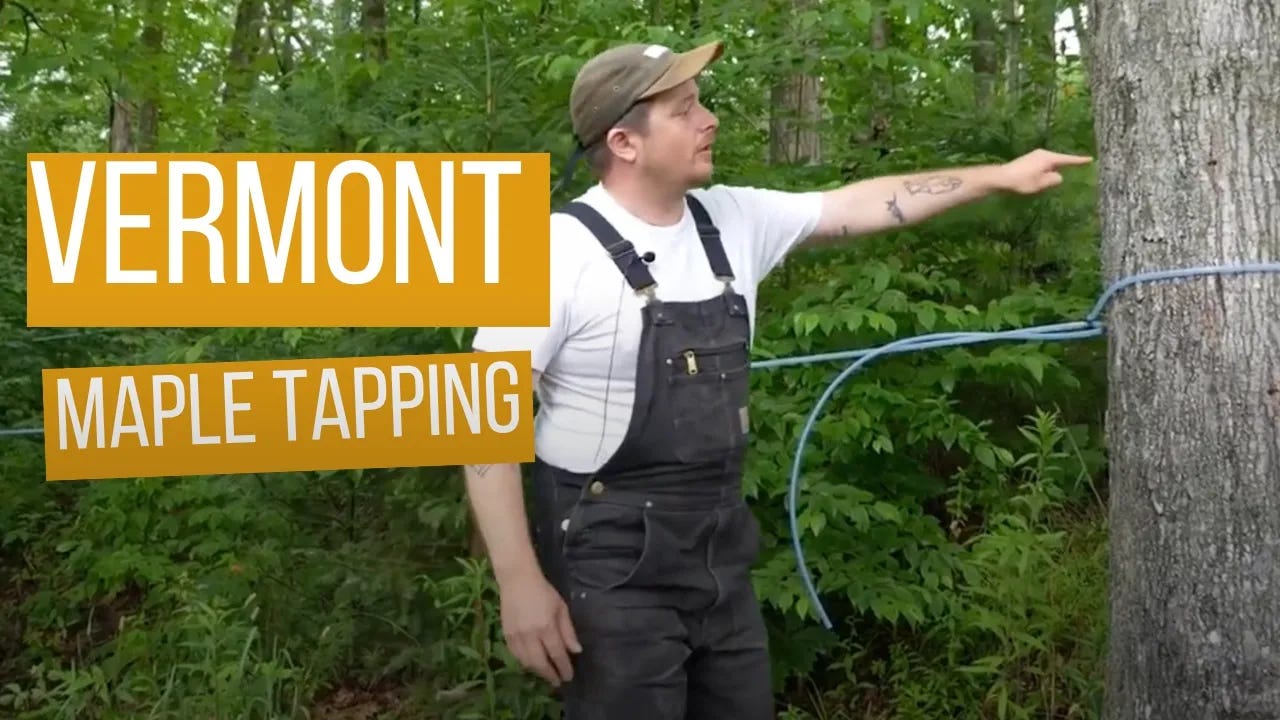
This week’s episode literally takes us into the woods. Walking us through Vermont sugarbush with Jacob and Jenna at Baird Farm Maple Syrup to break down something most people think they understand… but don’t.
Real Vermont maple syrup.
Maple syrup is one of the clearest examples of working within natural constraints. There is no forcing nature to scale. No forcing production once the window closes. No optimizing your way around tree biology.
You get a short season. You respect it. You make the most of it .Or you don’t make syrup. That reality makes sugaring worth paying attention to.
The Start of the Syrup You See on Shelves
In the episode, we start with a sugar maple tree named Phoebe.
From the outside, tapping a tree looks simple. Drill a hole. Insert a spout. Collect sap. But here’s what’s really happening.
Sap is water pulled up from the roots. Through photosynthesis, the tree stores energy as starch. As winter shifts toward spring, that starch converts to sugar. That sugar dissolves into the water moving through the xylem, the tree’s internal superhighway.
When farmers tap a maple tree, they drill about 1¾ to 2 inches past the bark and into healthy, conductive xylem.
Tree health determines yield. Sugaring isn’t guesswork. It’s careful management of living organisms you depend on for income.
On this farm, that means roughly 14,700 taps drilled before the season even starts. That’s before a single drop of sap flows.
The Most Important Sprint of the Season
One of the most important moments in the conversation was this:
Taps are drilled starting January 4 > Sap starts moving on February 26 > From February 26 to April 16 entire annual income is produced.
Then it’s over.
Sugaring ends when the buds open. Once trees shift toward leaf production, sap chemistry changes. Sugar concentration drops. Flavor turns. The season closes whether you’re ready or not.
The entire year’s revenue is determined in about 6 weeks.
That’s a level of biological dependence most modern industries have insulated themselves from. It’s not possible with maple syrup.
Sugaring in the Same Woods for Generations
There are trees on this farm that were tapped by Jenna Baird’s great-grandmother in 1918. Those same trees produced syrup this year.
There’s an abandoned sugarhouse in the woods built in the early 1970s. Before that, her great-grandmother’s operation stood on the same ground.
You feel time differently in places like that. You’re not just harvesting sap. You’re participating in a pattern that predates you and, if you do it right, outlasts you.
That’s the essence regenerative agriculture.
What This Really Shows Us
We talk a lot about resilience. Maple syrup production forces it.
You drill in the dead of winter. You work in thigh-deep snow. You wait for temperatures above freezing. You monitor tree health. You stop when nature says stop.
There is no workaround and no amount of investment will changes it. Even if you had a bigger sugarbush, they’d still follow the same schedule.
In a world obsessed with scale and speed, sugaring reminds us that some systems only function when you operate inside their limits.
If you haven’t watched the full farm tour and conversation yet, you can find it here.
Please leave a comment below, I guarantee you we read and respond to every single one.
And if you want more field-level conversations like this, subscribe. These stories turn viewers into readers and readers into long-term rebels building something better.