

Most people assume farms fail because farmers aren’t efficient enough. That if they just adopted the right technology, scaled faster, or optimized harder, they’d survive.
That assumption is wrong.
What’s actually breaking American agriculture is a hyper disconnected system built to maximize profits for corporations, lawyers, and spreadsheets, not for human beings stewarding land, raising animals, and feeding their neighbors. I sat down with Jason Wrich of Wrich Ranches to talk about what really keeps farms alive. Not subsidies. Not automation. Not bigger barns.
Community, or as he calls them ‘beef tribes’.
Jason recently began attending a twice-monthly farmer luncheon hosted by CSU Extension at the Rogers Mesa research station. It’s informal. No panels. No headlines. Just producers showing up and talking honestly.
These are real people who give a damn about their land and the people they are feed: Seed growers. Orchardists. Market gardeners. Ranchers. Farm-to-table restaurant owners.
Different operations. Same problems that keep them up at night.
What became obvious very quickly, Jason told me, is how interconnected everyone’s struggles are. And almost every conversation circles back to the same issue: over-regulation designed for corporations, applied to small producers.
“The rules are built for people who can afford corporate lawyers, not for the scale we’re actually working at.”
Jason shared an example that captures the problem perfectly.
A small vegetable producer might have a wash-and-pack room that’s four feet by ten feet. It’s clean. It’s functional. It’s all the space they have. But the regulation requires it to be six inches wider, because the rule was written for industrial wash systems.
Six inches…
That six inches triggers variance applications, consultants, paperwork, and costs the farmer simply can’t absorb. Meanwhile, large operations with legal teams glide through compliance without interruption.
This is how consolidation happens, not because small farms fail, but because they’re regulated out of existence. After all there are only 24 hours in a day and one-man or even family operations struggle to fill out all the forms and ensure they’re filed and somehow manage to actually operate.
And yet, this is where the story changes.
What rarely gets covered is what farmers like Jason do after they name the problem.
They collaborate.
Instead of each producer trying to build expensive infrastructure alone, Jason described conversations about shared facilities, common wash-and-pack spaces, shared processing, shared logistics. As Jason says,“It doesn’t make sense to have 50 wash packs when two could serve everyone.”
This isn’t ideology. It’s practicality. It’s how villages functioned for thousands of years, before industrial agriculture forced farming into spreadsheets and supply chains.
Bu the most powerful moment in our conversation came when Jason talked about money, not margins or profits, but the vulnerability when it gets tight..
There are times, he admitted, when the mortgage comes due and the math doesn’t quite work. That’s the reality of farming at human scale.
Jason once shared this honestly at a talk in Denver, in front of customers who buy his beef. What happened next surprised him.
Several customers stepped forward and offered to prepay for 5 years of beef, not for a discount, but to keep the ranch alive.
“They told me, ‘If you don’t succeed, we don’t know where we’re going to get our beef.’”
That’s the inversion industrial agriculture never accounts for. These weren’t customers acting charitably, they were protecting their own future food supply.
Jason refers to these people as his “beef tribe.”
Not an audience.
Not a demographic.
A tribe.
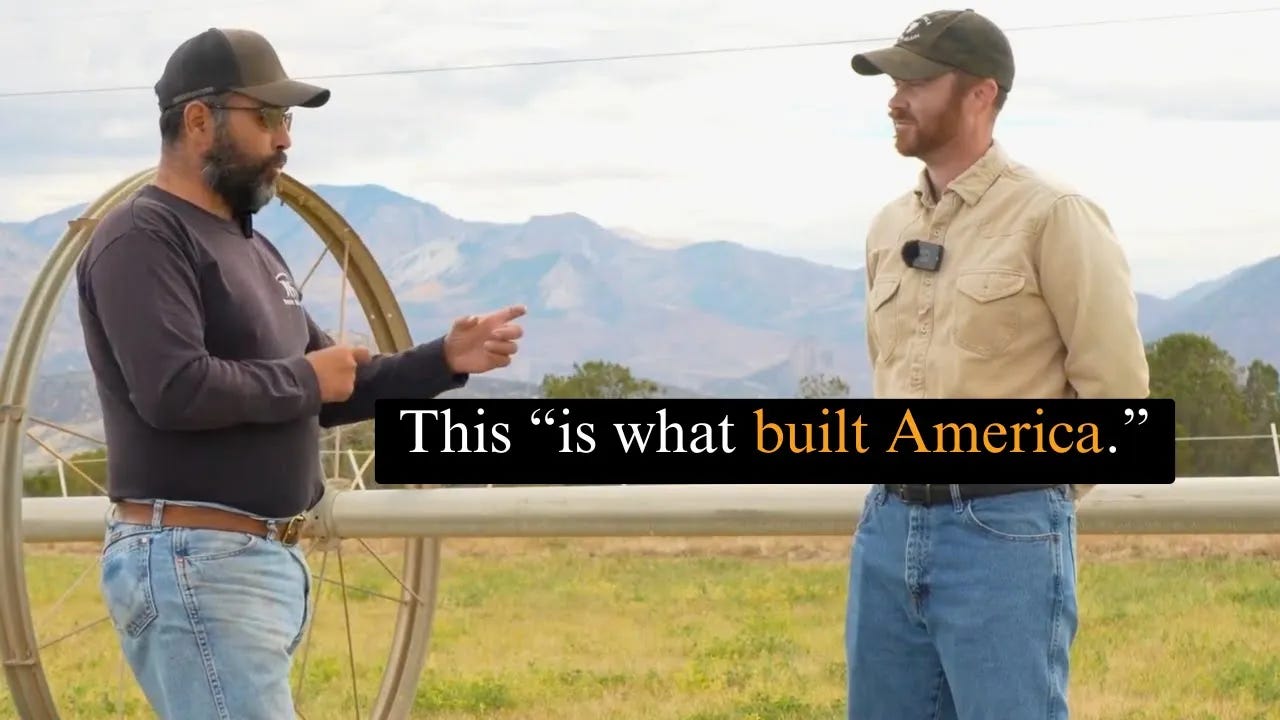
They receive updates from the ranch. Photos. Stories. Invitations to visit. The relationship takes priority over the transaction. As Jason says,“We’re rebuilding the village model—and that’s what built America.”
When people know the farmer, price stops being the first question. Longevity becomes the priority.
Thanks to longevity Jason has been able to adapt his approach to animal welfare creating something that’s as straightforward as it is rare.
Let cows be cows.
His cattle live their lives doing what they evolved to do. They aren’t forced into systems that ignore biology in the name of efficiency.
“Our cows only have one bad day. Literally.”
That reality stands in stark contrast to industrial feedlots, facilities housing hundreds of thousands of animals on concrete, dependent on trucked-in feed, massive water inputs, and endless waste removal.
Jason mentioned specifically a new feedlot in Nebraska with plans to reach 200,000 head of cattle, all on concrete.
When you hear numbers like that, it’s impossible not to think about what’s hidden.
The feed trucking.
The manure hauling.
The water use.
The downstream health costs.
“That system only works because the real costs don’t show up on the balance sheet.”
But they evolved that way to reduce the cost of one of Jason’s strongest convictions…processing is the choke point.
If every town had a local processor with a retail storefront, where people could buy locally raised beef, pork, lamb, or goat, the entire dynamic would change. Farmer incomes. Community health. Product value.
Right now, too many ranchers are locked into commodity systems that never allow them to capture the true worth of what they raise.
They do the hardest work, and receive the smallest share.
You know and I know, this conversation wasn’t really about beef.
It was about social capital, about what happens when people stop outsourcing responsibility for food and start taking ownership again.
Community-supported agriculture isn’t a niche concept. It’s a survival strategy for farmers, for towns, and for food security itself.
“Regenerative agriculture won’t scale through bigger corporations—it will scale through relationships.”
If we want real resilience in our food system, it won’t come from tighter regulations or larger facilities. It will come from trust, shared infrastructure, direct support, and people willing to say: we’re in this together.
That’s how farms survive.
That’s how food stays real.
And that’s how the village gets rebuilt, one relationship at a time.
Join the movement.
The future of food depends on it.
Viva La Regenaissance,
Ryan Griggs
Paid subscribers make conversations like this possible. They fund farm visits, honest reporting, and stories that don’t answer to corporate sponsors.
I encourage you to watch and hear the passion in Jason’s voice on how his ‘beef tribes’ changed the future of his ranch back when I visited.