

The Regenaissance is a reader-funded, platform for Regenerative Agriculture. Without your support, we couldn’t operate. Please consider becoming a paid subscriber so we can promote more farmers and their stories.
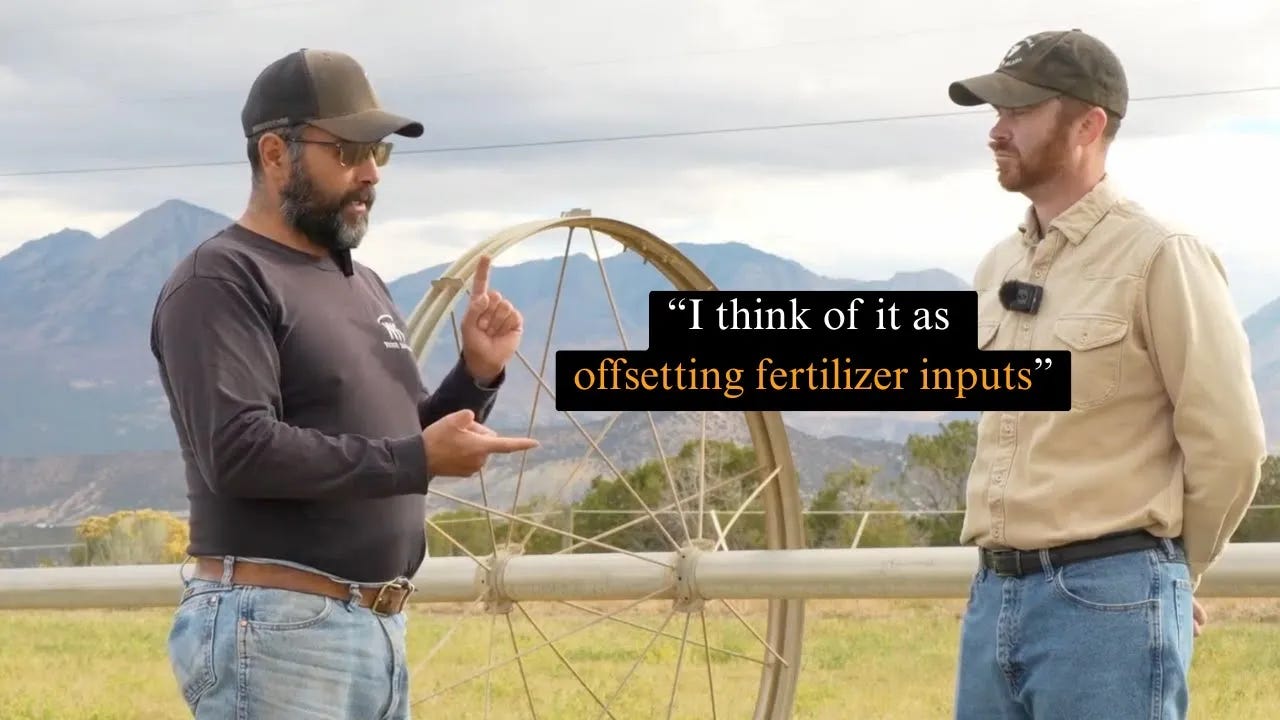
Every now and then a conversation reframes something you thought was simple. Not with jargon or charts or clever talking points, but with one quiet realization that rearranges how you see the whole system. That’s what happened during my conversation with Jason Wrich of Wrich Ranches.
We were talking about hay, about drought, feed costs, and survival. But somehow ended up talking about soil biology, fertilizer addiction, debt cycles, and the difference between extraction and stewardship. It turns out hay tells the whole story, because hay isn’t just feed. Hay is philosophy.
When Jason first got into cattle, he had what every beginner hopes for: two good years back to back. Rain came when it was supposed to. Grass grew. Hay stacked up. The operation felt predictable, almost generous. So he did what most people would do in that situation, he sold the excess hay.
Then the following year arrived, and with it came drought. Early, obvious, unforgiving. Jason could see the math before the season was over. There wasn’t going to be enough feed to get the herd through the year. And instead of waiting, hoping, or borrowing, he made a move that most people don’t have the stomach for. He sold half his cows, not in panic and not at the bottom, but early, while prices were still good.
By fall, cattle prices collapsed. In some places you couldn’t give cattle away. The national herd was bloated, markets were flooded, and desperation set in. Jason wasn’t spared because he was lucky. He was spared because he acted before the system forced his hand.
Resilience isn’t built by luck.
It’s built by acting before the system forces your hand.
That experience rewired how he thought about risk. Today, Wrich Ranches keeps a full year’s worth of hay in reserve. They don’t sell hay unless they absolutely have to for cash flow. They don’t assume next year will be good. They don’t trust averages. Because averages don’t feed cows during drought, reserves do. But the deeper shift wasn’t just about quantity. It was about meaning. Jason stopped seeing hay as an expense and started seeing it as something else entirely.
Hay isn’t an expense.
It’s a reserve.
No one thinks of hay as fertilizer, but it is. Every ton of hay contains nitrogen, phosphorus, and potassium, the same three nutrients printed on synthetic fertilizer bags across the country. But hay also carries something those bags never will: carbon, biology, structure, life.
Jason doesn’t use synthetic fertilizer. Everything on the ranch comes from organic chicken litter, their own manure, or hay fed through cattle and returned to the land. When hay comes onto the ranch, it isn’t just feed. It’s nutrients imported. It’s carbon added. It’s soil rebuilt. They bale-graze it. They roll it out intentionally. They feed it where land is thin or tired or depleted. Not randomly. Not efficiently. Deliberately.
“I’m not worried about how much hay costs.
I ask what fertilizer inputs it replaces, and what damage it avoids.”
Modern agriculture is very good at outsourcing thinking. You take a soil test. You get a recommendation. You follow the prescription. Rarely does anyone stop to ask what happens next. Synthetic fertilizer is salt. Salt changes soil chemistry. Salt disrupts microbes. Salt breaks fungal networks. Salt kills the unseen workforce beneath your boots. But because the consequences are downstream, slow, and invisible, they’re easy to ignore. Jason sees this everywhere, people doing exactly what extension tells them to do, exactly what the analysis says, exactly what they’ve always done, without ever asking whether the system is getting stronger or just louder.
That’s why regenerative agriculture feels polarizing. It’s not because of cows or cover crops. It’s because regenerative thinking challenges the core assumption of extraction. Most conventional systems are built on one question: what can I take this year? Regenerative systems ask a different one: what am I building over time?
Extraction asks what you can take this year.
Stewardship asks what you’re building over time.
Jason said something that stuck with me, most producers never thought about taking care of the land or biology. They thought about yield. They never thought about soil life. They thought about inputs. They never thought about stewardship. They thought about output. Regenerative agriculture forces you to zoom out, to see land as something you are responsible to, not just something you pull from. Once that shift happens, everything changes.
What people miss is that this isn’t romantic. It’s practical.
If you’re already fertilizing, why not redirect that money into hay?
If you’re already buying inputs, why not choose ones that rebuild instead of degrade?
If you’re already feeding cows, why not feed the soil at the same time?
Hay fed through cattle does three jobs at once:
it feeds animals,
fertilizes land,
and builds soil carbon.
Synthetic fertilizer does one job briefly and leaves damage behind. Suddenly hay prices don’t look so expensive. They look like long-term insurance.
Many conventional operations look beautiful from the road. Green fields. Straight rows. Clean edges. But beauty can be deceptive. Jason is careful not to paint all conventional farmers with one brush, but he’s honest about the system. Much of it is extractive by design. Take now. Replace later. Hope the bill doesn’t come due on your watch.
Regenerative thinking interrupts that cycle, and that makes people uncomfortable. Because once you see the land as alive, you can’t unsee it. Once you notice the soil responding, you can’t go back to ignoring it. Once you realize reserves matter more than averages, you stop gambling on good years. Jason keeps coming back to one simple idea:
“Shake the hand that feeds you”
None of this is visible in a grocery store. None of it fits on a label. None of it survives abstraction. You have to talk to the people doing the work. You have to walk the land. You have to hear why decisions get made. Only then does the story make sense. Only then do you see that food isn’t expensive, it’s been made artificially cheap by systems that mine soil, people, and rural communities until there’s nothing left.
Food isn’t expensive.
It’s been made artificially cheap.
This conversation wasn’t really about hay. It was about humility. About preparation. About refusing to outsource responsibility to systems that don’t care whether your land survives. Jason didn’t beat the drought. He respected it. And in doing so, he built something stronger than efficiency. He built resilience.
If this landed, it’s because you already sense the truth. Systems built on extraction eventually collapse. Systems built on stewardship compound. That applies to soil. It applies to food. It applies to communities. And it applies to us. If you want to hear Jason walk through this thinking in his own words and see how it plays out on real land, watch the full conversation, Hay, Soil Fertility, and a Regenerative Mindset, on YouTube. This isn’t theory. It isn’t nostalgia. It isn’t content. It’s how people who plan to be here tomorrow behave today.
Stay rooted. Stay observant. Stay unwilling to mortgage the future.
Viva La Regenaissance,
Ryan Griggs
I just shared a story from a 7th generation farm - would love for you to read it!
Maybe nutrients do, in a way, appear out of thin air once your soil has recovered. Manufactured out of your regenerated soil microbes, air, and sunlight.
"No added ingredients needed"