

The Regenaissance is built by its readers. Without your support, we can’t keep telling these stories or getting out on the land.
Before we start: I’m not a farmer. I’ve never moved a fence line, put animals on pasture, or had to decide whether to pull animals early because rain didn’t come. I’m learning this from conversations and farm visits I’m helping Ryan to produce.
If you run livestock or have more experience with these grazing models, can you help me learn more? As you read, drop a comment with what you’ve seen work, what’s failed, and where you disagree. That’s how I can learn and we can educate others in our community.
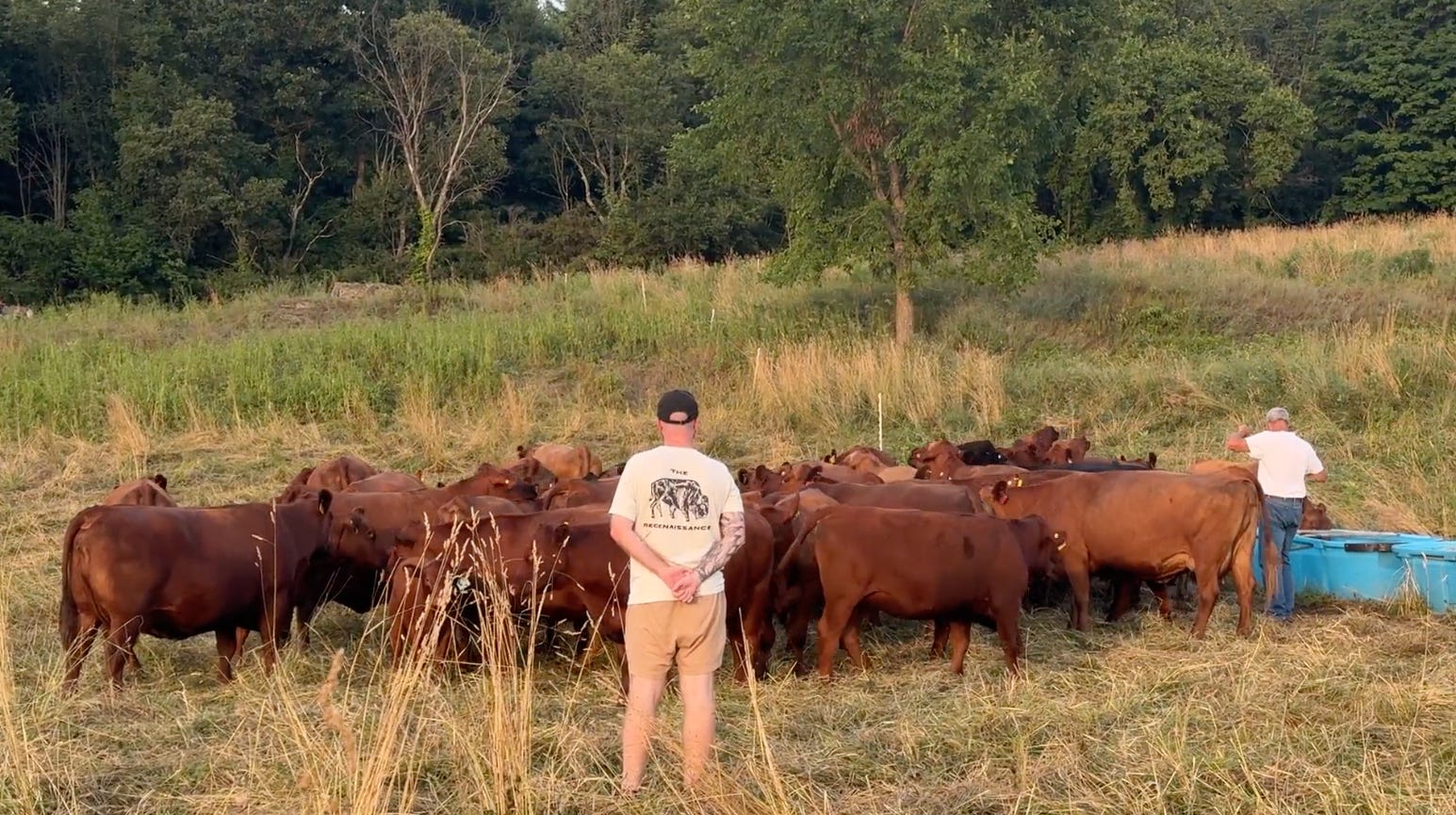
Adaptive Multi-Paddock (AMP) grazing is something I’ve heard about ALOT, often as the gold standard of regenerative grazing. The gist is usually that once you adopt AMP, you’ve “figured it out.”
But the more I listen to farmers’ stories and watch their operations, the clearer something becomes: there isn’t a single grazing system that works everywhere, all the time.
Every system I’ve seen (set-stock, rotational, mob, or AMP) has situations where it works well and situations where it breaks down. What I’ve learned is that the difference isn’t the label. It’s how rigid or responsive the management behind it is.
And in practice, these grazing methods sit on a spectrum:
Set-stock (continuous grazing) → Traditional rotational grazing → Mob grazing → Adaptive multi-paddock grazing
To me what separates them isn’t philosophy. It’s flexibility.
The Core Difference Between Grazing Systems
At a high level, grazing systems differ across four variables:
Stock density (animals per acre at a moment in time)
Duration of grazing (how long animals are pasture)
Length of soil recovery (time animals are off-pasture)
Flexibility of decision-making
Everything else is detail.
The more I learn, the more it seems that regenerative success isn’t about maximizing any one of these variables but adjusting them based on what’s actually happening on the land.
Set-Stock (Continuous Grazing)
In set-stock systems, animals stay on the same pasture for long periods with little or no movement.
Strengths
Low labor
Minimal infrastructure
Simple to manage
Limitations
Chronic overgrazing of preferred plants
Uneven manure distribution
Weak root systems and soil degradation
Declining forage quality over time
Set-stock systems optimize for ease, not resilience. They work until they don’t, and when they fail, the pasture usually tells you first.
Common signs set-stocking may be working against you:
Animals keep returning to the same spots: Livestock are grazing the same areas over and over while other parts of the pasture grow tall and go untouched.
Bare ground shows up around water, shade, or gates: Soil exposure increases where animals spend the most time, leading to compaction, runoff, and erosion.
Weeds start replacing grass instead of filling gaps: Animals are only eating their favorite grass so less tasty plants start taking over the pasture.
Pasture looks uneven all season: The pasture never looks uniformly healthy with patches of grasses and large barren areas.
Forage runs out earlier than it used to: Hay is being brought in sooner each year even though rainfall is the same.
Recovery after grazing gets slower over time: Grass takes longer to bounce back, or never fully does, even in good growing conditions.
Carrying capacity quietly declines: The same number of animals are run on the same pasture, but the land looks more “tired” every year.
None of this happens overnight. Set-stock systems usually unravel slowly, until one dry year or one feed bill exposes the limits.
Traditional Rotational Grazing
Rotational grazing divides pasture into paddocks, moving animals on a set schedule and resting ground between grazings.
Strengths
Built-in rest and recovery
Better forage utilization
Improved manure distribution
Reduced parasite pressure (especially for sheep)
Limitations
Often schedule-driven rather than growth-driven
Can still over- or under-graze if timing is wrong
Limited responsiveness to weather variability
Rotational grazing is considered a major improvement over set-stocking, but only as good as the assumptions baked into the rotation.
Most rotational systems are built around fixed decisions:
Animals move every 7 days
Paddocks rest for 28 days
Stocking rates stay constant
The problem is that grass doesn’t grow on a schedule.
Growth rates change with temperature, moisture, day length, soil health, and previous grazing pressure. When rotations don’t adjust, two failures show up:
Grazing too early, weakening roots and long-term productivity
Grazing too late, producing mature, tall grasses that animals selectively avoid
In both cases, the system rotates but management isn’t adapting to the land conditions.
Without constant feedback, rotational grazing becomes set-stocking with movement. Better than nothing, but not regenerative by default.
Mob Grazing
Mob grazing uses ultra-high stock density for very short periods, followed by long recovery.
Strengths
Strong soil impact and manure compacting
Uniform grazing and trampling
Weed suppression
Rapid changes in ground cover
Limitations
High labor and management intensity
Lower short-term animal performance if forage is mature
Not well suited for all classes of livestock year-round
From the outside, mob grazing looks extreme. From what I’ve seen, it’s better understood as a tool, not a system.
When used intentionally to reset pasture, knock back weeds, or build litter, it can be powerful. When used everywhere, all the time, warning signs appear.
Common signs mob grazing may be working against you:
Animals look less healthy despite “plenty of grass”: Pasture looks tall, but forage is too mature or fibrous, forcing animals to eat low-quality feed.
Excessive trampling with slow or weak regrowth: Litter builds up, but plants struggle to recover beneath it.
Soil stays compacted instead of loosening: Hoof impact outpaces recovery. Instead of healthy looking soil, the surface is tough and puddles after rain.
Recovery periods become guesswork: Long rest is assumed to be beneficial, but paddocks are re-grazed before they’re truly ready or left too long and go rank.
Labor load overwhelms management capacity: Moves become rushed or inconsistent, maximizing movement not animal or soil health.
High-stress classes of livestock underperform: Dairy cows, growing stock, or lactating animals struggle to meet nutritional needs on mature forage.
Weeds persist despite heavy impact: Trampling alone doesn’t reset plant communities without proper recovery and grazing control.
From where I’ve seen this model used and what I’ve read, intensity alone doesn’t regenerate land. Matching impact to conditions does.
Adaptive Multi-Paddock Grazing (AMP)
AMP grazing borrows from rotational and mob systems but rejects fixed rules.
Instead of asking “How many days per paddock?” it asks:
How fast is the forage growing right now?
What stage of recovery is this paddock actually in?
What do the animals need this week?
What impact do I want here: harvest, trampling, rest, or avoidance?
Strengths
Responds to real biological signals
Balances animal performance and ecosystem recovery
Scales across species and climates
Avoids dogma
Trade-offs
Requires observation and decision-making
Less “set it and forget it”
Demands comfort with uncertainty
AMP grazing isn’t a formula. It’s a management discipline that pays attention early instead of reacting late.
Two farms can both “do AMP” and look completely different. What they share isn’t paddock size or move timing. It’s decision-making rooted in biology instead of routine.
AMP doesn’t replace other systems. It governs how and when they’re used.
Choosing the Right System Isn’t About Labels
The real question isn’t:
“Which grazing system is best?”
It’s:
“How much flexibility does this farm need and how much management can it support?”
A useful rule of thumb:
Low labor, low flexibility → Set-stock
Moderate labor, moderate flexibility → Traditional Rotational
High labor, targeted impact → Mob
Variable labor, high responsiveness → AMP
Most regenerative farms move along this spectrum over time. Seasons change. Finances change. Experience changes.
What separates success from failure isn’t stocking density or paddock count. It’s whether management is:
Calendar-driven or biology-driven
Rule-based or feedback-based
Static or responsive
Adaptive grazing works not because it’s complex, but because it lets reality lead. And from the outside looking in, that seems to be what regeneration actually requires.
I’m still learning this, but like I said earlier I’ve never done it. One day I want to own my own land and I’d truly appreciate your insight.
If you manage grazing systems, I’d love to hear from you in the comments:
What’s worked on your land? What failed? Where do you think I miss the mark?
That shared experience is how we can help more people learn about regenerative agriculture